My wife knows.
When we are watching a movie, she knows that the minute they show someone paddling a canoe, I will tense up. Clearly I want to say something, but I am holding back. She knows that I want to complain about how Natalie Portman can study ballet for a year to play the lead in Black Swan, but the producer of this film apparently can't spare $30 to hire some summer camp recreation director for 1/2 hour to teach his lead actors how to properly paddle a canoe. She knows that my barely suppressed rage at this travesty is only surpassed by my knowledge that she has forbidden me to speak on the subject ever again. Ever.
That's what happens when you rant one too many times, I guess.
It's just that it jars me out of my willing suspension of disbelief when the supposedly woodscrafty hero, a man wise and skilled in the ways of making his way through the wilderness can't even paddle a gosh darn canoe straight without switching sides every 3 strokes and getting water in the boat to boot. Drives me up a wall.
The movies just can't seem to get the details right.
In the same way, it seems that neither script writers, nor directors nor any actor seems to be able to get the portrayal of religious belief right on the screen. It seems lately that almost every time some religious thread is introduced into a story, something about the way it plays just seems off. It seems off in almost the same way as when you are trying to speak to someone with eyes that point two different directions. All the pieces of the face are there, but it's all just far enough off the mark to make the result disconcerting.
I can understand how this can happen. If you have never had an authentic religious experience, if you have not had extensive firsthand familiar with the religious subculture and the real people that live it, or even more importantly if you do not respect religious folk enough to look past the surface, it is almost a given that the result will tend more to caricature than to characterization. To authentically portray such people, you may not need to be one of them, but you must have a certain sympathy and certainly a real familiarity with them as people. Otherwise your dialogue will never rise above a ragtag collection of religious cliches. I watch these plays and the words jar me in the same way as a poorly paddled canoe.
I recently viewed a video on youtube that comes from a completely opposite pole. In our film, television, books and stories, missionaries are mostly vilified. They are presented variously as cultural imperialists, deluded naifs, or corrupt powermongers, just to name a few options. Quick. Do an inventory of all the films and stories you have viewed which include missionaries. How many actually treat the missionary with any type of real respect or seriousness? Include pastors and priests in that mix.
I know missionaries. I grew up with missionaries. The fact is that they are real people who are seeking to live out their real faith in direct confrontation with a real world. The most important thing, beyond all else, is that they help the people to whom they go. As people, they are just as susceptible to all human stumblings. Nevertheless, in so many cases the work they do is highly valued by the people with whom they choose to live and love and help.
This youtube video struck me because it takes the viewpoint of the people helped by christian missionaries. And not just in terms of medical care, agricultural training or food relief. No, these people are joyful from the deepest place and grateful to the missionaries for the MESSAGE that has been brought to them. There is no acting, no mediating by writers or directors to dilute the genuine joy with which these people greet the coming of God's Word in their language to their people.
It seems to me that the testimony of these people is worth far more than that of most filmmakers and TV producers.
In fairness, I have to point out that the people aren't rejoicing over the missionaries. But they are certainly rejoicing over the gift the missionaries have brought to them. I suspect that this type of occurrence is more common than we know. It should be shown on Nightline, 60 Minutes, and 20/20 more often, but it doesn't really align with the popular understanding of how the work of missionaries are received by the people to whom they minister.
It's just not like in the movies.
Showing posts with label bible. Show all posts
Showing posts with label bible. Show all posts
Thursday, March 3, 2011


Wednesday, October 6, 2010
It's Not About You
A few weeks ago, I had another opportunity to speak at a retreat, this time to the student body of Jesse Remington High School. We had a group of about 40 students who gathered at the Horton Center on Pine Mountain, overlooking Gorham, for a few days focused on building their life as a learning community. Yeah. I know. But that's just the kind of school Jesse Remington is.
As with my previous retreat experience, I tried simply to open up the Gospel to these kids, trying to help them see it through fresh eyes. Rather than expound the text, I tried to read the text. Rather than preach the 3 point sermon I worked at telling the 3 chapter story. Rather than set forth the three propositions, I tried to frame 3 pictures of the Gospel from what I hoped was a fresh new perspective.
I say this because when I approach speaking or preaching on the Gospel, I stay away from a scholarly approach because I am not a scholar, a philosopher or a particularly deep thinker. I just don't have the training for it. My approach is more pastoral -- what in this text will feed His sheep?
And even taking a pastoral approach, I still tend to avoid the heavy lifting of exegeting the original languages to make a fine theological point. Again, partly because I lack the training. But even moreso, the most useful thing to feed the flock isn't a new insight into the aorist tense in the original Greek. Nor is it another insight into the Pauline logic of the doctrine of justification.
The most useful thing for feeding the flock is pictures. Clear, powerful, visceral, emotionally charged pictures that teach us about who God is and what he has done.
That's at least part of the reason why Jesus left us with two basic practices around which he builds his church -- baptism and eucharist. These are first and foremost living pictures of him and his grace. Even better, they are not pictures that we merely gaze upon. They are pictures in which we partake -- we are included in the picture.
Chew on that.
I kind of wish I had this video a few weeks ago. I would have shamelessly stolen from it, because it makes the point I worked so hard to make to those students in the mountains.
As with my previous retreat experience, I tried simply to open up the Gospel to these kids, trying to help them see it through fresh eyes. Rather than expound the text, I tried to read the text. Rather than preach the 3 point sermon I worked at telling the 3 chapter story. Rather than set forth the three propositions, I tried to frame 3 pictures of the Gospel from what I hoped was a fresh new perspective.
I say this because when I approach speaking or preaching on the Gospel, I stay away from a scholarly approach because I am not a scholar, a philosopher or a particularly deep thinker. I just don't have the training for it. My approach is more pastoral -- what in this text will feed His sheep?
And even taking a pastoral approach, I still tend to avoid the heavy lifting of exegeting the original languages to make a fine theological point. Again, partly because I lack the training. But even moreso, the most useful thing to feed the flock isn't a new insight into the aorist tense in the original Greek. Nor is it another insight into the Pauline logic of the doctrine of justification.
The most useful thing for feeding the flock is pictures. Clear, powerful, visceral, emotionally charged pictures that teach us about who God is and what he has done.
That's at least part of the reason why Jesus left us with two basic practices around which he builds his church -- baptism and eucharist. These are first and foremost living pictures of him and his grace. Even better, they are not pictures that we merely gaze upon. They are pictures in which we partake -- we are included in the picture.
Chew on that.
I kind of wish I had this video a few weeks ago. I would have shamelessly stolen from it, because it makes the point I worked so hard to make to those students in the mountains.
Sunday, September 5, 2010
Affectionate Insults
I just returned from a weekend in the mountains of mountains of NH where I was engaged as the speaker at a Christian men's retreat. Good men. Good times.
I was amazed and delighted to experience that wonderful atmosphere of affectionate insult that pervades the banter of men who have known each other for a long time, and love and respect each other. It might appear, if one were to read a transcript of the event, that these men loved to spite one another. But when you hear the tone of voice and see the expressions on faces, you realize that the deepest insults are also the most loving compliments. I think the term is "good natured ribbing." You only hurt the ones you love.
It's a guy thing.
Our teaching focus was an attempt to uncover fresh perspectives on the Gospel. Much of the material are ideas that I have only recently learned myself, but which has deeply shaped my heart. It reminded me of this post from 2007.
I was amazed and delighted to experience that wonderful atmosphere of affectionate insult that pervades the banter of men who have known each other for a long time, and love and respect each other. It might appear, if one were to read a transcript of the event, that these men loved to spite one another. But when you hear the tone of voice and see the expressions on faces, you realize that the deepest insults are also the most loving compliments. I think the term is "good natured ribbing." You only hurt the ones you love.
It's a guy thing.
Our teaching focus was an attempt to uncover fresh perspectives on the Gospel. Much of the material are ideas that I have only recently learned myself, but which has deeply shaped my heart. It reminded me of this post from 2007.
Tuesday, June 8, 2010
An Incomplete Manuscript
"What we must notice at this stage is that, both in the Old Testament and in the New, the present suffering of the world – about which the biblical writers knew every bit as much as we do – never makes them falter in their claim that the created world really is the good creation of a good God. They live with the tension. And they don’t do it by imagining that the present created order is a shabby, second-rate kind of thing, perhaps (as in some kinds of Platonism) made by a shabby, second-rate sort of god. They do it by telling a story of what the one creator God has been doing to rescue his beautiful world and to put it to rights. And the story they tell…indicates that the present world really is a signpost to a larger beauty, a deeper truth. It really is the authentic manuscript of one part of a masterpiece. The question is, What is the whole masterpiece like, and how can we begin to hear the music in the way it was intended?
The point of the story is that the masterpiece already exists – in the mind of the composer. At the moment, neither the instruments nor the players are ready to perform it. But when they are, the manuscript we already have – the present world with all its beauty and puzzlement – will turn out to be truly part of it. The deficiencies in the one part we possess will be made good. The things that don’t make sense at the moment will display a harmony and perfection we hadn’t dreamed of. The points at which today the music seems almost perfect, lacking just one small thing, will be completed. That is the promise held out in the story. Just as, in one of the New Testament’s greatest claims, the kingdoms of this world are to become the kingdom of God, so the beauty of this world will be enfolded in the beauty of God – and not just the beauty of God himself, but the beauty which, because God is the creator par excellence, he will create when the present world is rescued, healed, restored and completed."
N.T. Wright in Simply Christian:Why Christianity Makes Sense. Harper Collins hardcover p 47.
 "
"The point of the story is that the masterpiece already exists – in the mind of the composer. At the moment, neither the instruments nor the players are ready to perform it. But when they are, the manuscript we already have – the present world with all its beauty and puzzlement – will turn out to be truly part of it. The deficiencies in the one part we possess will be made good. The things that don’t make sense at the moment will display a harmony and perfection we hadn’t dreamed of. The points at which today the music seems almost perfect, lacking just one small thing, will be completed. That is the promise held out in the story. Just as, in one of the New Testament’s greatest claims, the kingdoms of this world are to become the kingdom of God, so the beauty of this world will be enfolded in the beauty of God – and not just the beauty of God himself, but the beauty which, because God is the creator par excellence, he will create when the present world is rescued, healed, restored and completed."
N.T. Wright in Simply Christian:Why Christianity Makes Sense. Harper Collins hardcover p 47.
Wednesday, October 22, 2008
Three Old Men Throwing Olives
You are going to have to suffer through my Capon period for a while yet. Here is another quote, this one from his book The Third Peacock: The Problem of God and Evil. Stick this one in your pipe and smoke it.
Let me tell you why God made the world.
One afternoon, before anything was made, God the Father, God the Son and God the Holy Ghost sat around in the unity of their Godhead discussing one of the Father’s fixations. From all eternity, it seems he had had this thing about being. He would keep thinking up all kinds of unnecessary things—new ways of being and new kinds of beings to be. And as they talked, God the Son suddenly said, “Really, this is absolutely great stuff. Why don’t I go out and mix us up a batch?” And God the Holy Ghost said, “Terrific, I’ll help you.” So they all pitched in, and after supper that night, the Son and the Holy Ghost put on this tremendous show of being for the Father. It was full of water and light and frogs; pine cones kept dropping all over the place and crazy fish swam around in the wineglasses. There were mushrooms and grapes, horseradishes and tigers—and men and women everywhere to taste them, to juggle them, to join them and to love them. And God the Father looked at the whole wild party and he said, “Wonderful! Just what I had in mind! Tov! Tov! Tov!” And all God the Son and God the Holy Ghost could think of to say was the same thing. “Tov! Tov! Tov!” So they shouted together “Tov meod!” and they laughed for ages and ages, saying things like how great it was for things to be, and how clever of the Father to think of the idea, and how kind of the Son to go to all that trouble putting it together, and how considerate of the Spirit to spend so much time directing and choreographing. And forever and ever they told old jokes, and the Father and the Son drank their wine in unitate Spiritus Sancti, and they all threw ripe olives and pickled mushrooms at each other per omnia saecula saeulorum. Amen.
It is, I grant you, a crass analogy; but crass analogies are the safest. Everybody knows that God is not three old men throwing olives at each other. Not everyone, I’m afraid, is equally clear that God is not a cosmic force or a principle of being or any other dish of celestial blancmange we might choose to call him. Accordingly, I give you the central truth that creation is the result of a Trinitarian bash, and leave the details of the analogy to sort themselves out as best they can.
One slight elucidation, however. It is very easy, when talking about creation, to conceive of God’s part in it as simply getting the ball rolling—as if he were a kind of divine billiard cue, after whose action inexorable laws took over and excused him from further involvement with the balls. But that won’t work. This world is fundamentally unnecessary. Nothing has to be. It needs a creator, not only for its beginning, but for every moment of its being. Accordingly, the Trinitarian bash doesn’t really come before creation; what actually happens is that all of creation, from start to finish, occurs within the bash—that the raucousness of the divine party is simultaneous with the being of everything that ever was or will be. If you like paradoxes, it means that God is the eternal contemporary of all of the events and beings in time.
Friday, September 12, 2008
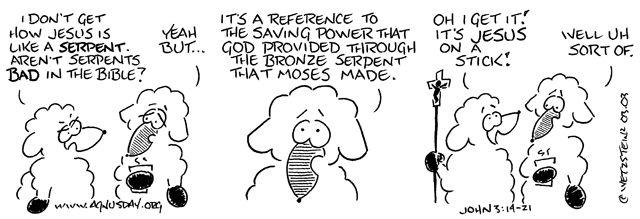
Jesus on a Stick
Recently discovered a site that offers cartoons that correspond to the scripture passages offered in the Lectionary. Presumably the Revised Common Lectionary, since the cartoonist is a Lutheran pastor. And then there is the name. Agnus Day. Get it?
Cartoons that follow the lectionary. Gotta love that. Is this a great country or what?
This particular one is pretty funny. I think it will will be especially meaningful to my friends who are Jehovah's Witnesses. If you don't get the joke, ask your local neighborhood JW if they will explain it to you.
Monday, October 22, 2007
God's Bombs
I recently had the opportunity to preach on a Sunday morning. Our Pastor was away, he asked me to fill the pulpit duties for him on that day. This is not the first time I have done so, but it is always a strange experience for me. The strangeness has nothing to do with standing up before a large assembly to speak – I do that for a living so there is no mystery there. It has much more to do with the nature of preaching itself.
Whenever I prepare and deliver a sermon, I am powerfully aware that what I am doing is akin to handling dynamite. The power inherent in THE WORD is always latent -- until it becomes manifest. And then all bets are off. Anything can happen. In Hebrews 4:12, the writer likens God’s word to a two edged sword, a devastating weapon. He compares it for it’s ability to cut through armor and clothing and flesh and bone, just as God’s message cuts through our defenses and into the very center of our beings. If the Writer were writing this today, he might choose a more powerful and modern weapon for his metaphor. Perhaps a Rocket Propelled Hand Grenade, or a Barrett M82A1 .50 caliber Sniper Rifle. One would certainly exhibit a great deal of care when handling an extremely sharp blade. How much more so with modern ordinance capable of extraordinary destruction upon the slightest press of a trigger.
But God's Word works as a kind of reverse dynamite. It can indeed blow up your life, but the blowing up only feels like destruction. What is destroyed is the former self. What emerges from the dust and rubble is the new man. It would be like building a house by tossing a couple of sticks of dynamite into a grove of trees. It wouldn’t work with dynamite and actual trees, but somehow, when you throw the Word of God into a grove of people, God uses the resulting explosions to build His kingdom. Go figure.
As I was pondering this most recently, it also occurred to me that if I’m feeling a little nervous about doing the preaching for this reason, then how should I feel about HEARING the preaching? After all, when I’m listening to the Word of God, the grenades are being launched at me. YIKES! Makes one sit up a bit straighter and feel more alert. One may not be able to avoid being shot at, but one might should pay attention to see it coming. I understand the soldiers in combat often develop a rather ambivalent attitude toward bullets and bombs, figuring that if it’s meant for me, then it’s gonna get me. There is no escaping, once God has you in his sights. His aim is accurate, and his weapons are unstoppable. If He means it for you, you are done for.
But NOT done for. In fact, if He means it for you, you are just getting started. You don't die -- you live more completely and more fully than before. Again, the metaphor is like the negative of the truth. It makes everything look strange because all the colors are reversed. God’s bombs heal us. God’s bombs put things in their right places. God’s bombs bring peace. The process may feel a lot like getting blown up, but the ultimate end is reassembly of the shattered walls of creation.I think I’ll always be a little nervous when I preach. I think I’m learning to think more clearly when I receive the Word as well. I shall try to resist the urge, upon the reading of the lesson, to duck under the chair while shouting, “INCOMING!”
Monday, April 9, 2007
Thoughts on Holy Week
Warning: You are about to jump into the middle of crude theological musings of an amateur. Read on at your own risk.
I had intended to post about Good Friday, and again about Resurrection. Well….I suppose I’m a little late for that. In an attempt to remain at least slightly current, here are snapshots of some musings on Holy Week.
Maundy Thursday – I was powerfully reminded this week of a time when, as a teenager, I met with 3 other boys for Bible study with Joe Coughlin, a local pastor. In the middle of one session, he stood up and walked out of the room with short instructions for us to remove our shoes and socks. We all looked at each other wondering if he was serious. He walked back in with a towel and basin, and reminded us agin to take off our shoes. He then knelt down and proceeded to wash our feet. We were…I’m not sure quite how to describe our feelings. Horrified seems too strong, but it just seemed so wrong for Him to be doing something so humbling. Pastor Joe was one of the most powerful mentors of my youth and we all had the greatest respect for him. I can easily identify with the response of the disciples when Jesus did the same for them. It was a powerful lesson that I have never forgotten.
You call Me Teacher and Lord; and you are right, for so I
am. If I then, the Lord and the teacher, washed your feet, you also
ought to wash one another's feet. For I gave you an example that you also
should do as I did to you. Truly, truly, I say to you, a slave is not
greater than his master, nor is one who is sent greater than the one who sent
him. If you know these things, you are blessed if you do them.
Good Friday – I have never really understood the concept of substitutionary atonement. Actually, I grasp the concept. I have never really understood the mechanics. How is it exactly that someone else can pay for my sin. If I commit murder, how is it that someone can serve my prison sentence, or even be executed in my place? There is no such thing as substitution in any law that I’m familiar with – except for that whole Kingdom of God thing. In theology classes, I was told that it’s possible because a) Jesus is perfect and b) Jesus is infinite by nature of his divinity. This never really seemed to me to solve the problem. How does Jesus’ suffering and death justify me?
The closest I’ve been able to come to getting this is the Deep Magic and the Deeper Magic referred by Aslan in Narnia. I know that Narnia is not a theological treatise or a book of biblical exposition. And, it doesn’t really EXPLAIN it, so much as it puts a label on it. Interesting label too. Magic. Hmmmm.
There is that about the atonement that is magical. The blood. The sacrifice. The words of power. I guess though, when YAHWEH sets it up, that’s how it is. I don’t really have to understand something to believe in it or even take advantage of it. I could list a whole bunch of stuff the inner workings of which I remain largely ignorant (automobiles, televisions, refrigerators) but that doesn’t stop me from pressing the button and watching the pretty pictures.
So I believe in the atoning work of Christ. Absolutely. It just remains a mystery. My overwhelming thoughts and emotions this week were simply a deep sense of gratefulness for it. Deep gratefulness. I need it.
Enough for now. I’ll rant on the Resurrection in a few days.
Subscribe to:
Posts (Atom)


 Posts
Posts


