Showing posts with label heat. Show all posts

Thursday, November 19, 2009

Mindful Warmth 5 - Burning


This is one of a series of articles on my recent experiences burning wood to heat my home. You can read the earlier articles by clicking on the links below:

________________________________________________________


To light a fire seems like such a simple thing, and it really is if you have good tinder, sufficient dry kindling, a good supply of fuel logs, and (this is critical) a lighter or a few matches. Simple.

Try doing it without a match.


Even with a lighter, it takes a modicum of skill to get a good fire going quickly and with a minimum of smoke and fuss. This is important because the fire in question is inside my house. Therefore, any smoke won’t harmlessly drift off in the breeze. It will suffuse itself throughout the rooms of my house and settle on everything. Not a big deal perhaps until you consider what an entire winter of smoke will do to your wardrobe, your furniture, your carpets. Everything takes on a kind of sour unpleasant smell – not at all the delightful flavor you get from things which are properly smoked like, oh bacon for instance.

I soon learned that the idea is to get a good hot blaze going very quickly to heat the stove up as fast as possible. The heat creates a strong draft that will pull all the smoke up the chimney and outside where it belongs. The quicker things heat up, the stronger the draft. I learned to facilitate this by leaving the stove door open about a half an inch to allow lots of oxygen to feed the flames. Once things are going cheerily, I can close the door, and the stove will draw air in through the controlled damper system in the back. According to the owner’s manual, this system draws air in underneath the fire so that it burns from the bottom, allowing a more complete and controlled burn. It seems to work, as we always end up with a very find ash indicating that all the wood has burn quite thoroughly, yielding up every last BTU latent in the fibers.

Before lighting, I like to build the fire structure. The tinder goes first. I find that newspaper works well if twisted tightly into mini logs so that it burns longer. Paper egg cartons do well for tinder, as does cardboard especially if rolled up into tight spiral tubes. I recently tried paper milk cartons and found that these work wonderfully. They are waxed cardboard, and the combination of wax and paper burns evenly and long so that the flames have plenty of time to catch the tinder.

For kindling I have been using the small chips that inevitably collect around the stump during the splitting process. I periodically gather them up so that they don’t get underfoot and make my stumble, and place them in a large covered plastic bin. They dry quickly and when dry catch fire very easily. While this works well, I can see that I won’t have nearly enough of this to last the winter. So I’m going to have to make my own kindling. Easy with a small hatchet and a few dry logs. It’s a matter of a few minutes to split them down into sticks, enough kindling for a few days. You do have to mind your fingers.

I have also been the recipient of a gift of two barrels full of wood scraps from some finish carpentry project or other. This is kiln dried pine. It catches on fire very easily and make good kindling.

One the kindling is cracking and roaring a bit, I will place a few good sized logs on. My woodpile has been drying for about 18 months now, and the wood is well seasoned and burns easily and well. I don’t hear much sizzling, which is the sound you get when moisture is coming out of the wood as it is getting ready to burn. Just good clean low roar of flames and oxygen coming together and casting a nice warm glow that spreads through my entire house.


Once the stove is warmed up, the radiant heat warms the floor and walls of the house. The warmed air moves upstairs into the bedrooms to warm those spaces. Once it is warmed up I find tossing on a log about every 45 minutes or so will keep things going nicely. It really doesn't take that much. Once I piled it up pretty high, and I could tell things were getting a little too hot. I closed the damper in back a little to slow down the airflow and things settled down to a slower more even burn. I'm sure that as the winter moves on, I will learn more about how to keep the stove going efficiently.

Being warm in winter makes my bride happy. I look forward to a happy winter.

Wednesday, November 11, 2009

Mindful Warmth 4 - Moving

This is one of a series of articles on my recent experiences burning wood to heat my home. You can read the earlier articles by clicking on the links below:

________________________________________

From WOODPILE

I have learned that wood must be moved several times during processing operations, and much of the effort of wood heating simply involves the act of moving it around. It seems that each chunk of wood must be moved a minimum of three times, although 4-5 times seems to be more common as I am still figuring out the best way to manage the whole process.

Actually, I am not so much managing the process just yet. I am inventing it. My mind is often taken up with figuring the most efficient layout for the various piles, scheming to find the materials to build the sheds and platforms, planning the placement and construction of each, and flowcharting it all in my head. None of it happens spontaneously. Unless I pick it up and make it happen, the wood just sits there until is sprouts mushrooms and returns back to the soil, it’s BTU’s unused. The brainpower required really is enormous. It's a good thing I have plenty to spare.

At this point, the process looks kind of like this:

Once dumped out of the truck or trailer, the large chunks must be moved to the splitting area. I usually will do this a few at a time as I need them. Once split, the logs must be moved to a drying area. For this I am using my main woodshed (actually, a platform). Since the main woodshed is still full of this year's fuel, I am preparing a secondary drying area on a group of wood pallets nearby. Once the wood in the woodshed is depleted, the pile of recently split logs on the pallets will replace it and will remain there to dry until next winter.

The main woodshed is a walk of perhaps 100 feet from the back door. Not bad in the summer, but verging on the inconvenient in 10 below January weather, with the snow hip deep. To make that trip daily to haul up the day's heat may get tedious. Therefore I have plans to stage the dried wood to a smaller intermediate woodshed near our back door. Then a load or two at a time, it will be brought inside to warm up – apparently placing cold wood in the stove is a waste of energy. Then it will finally be placed in the stove to burn.

So, my latest project is building that small woodshed on the back porch. The plan is for this woodshed to hold several weeks of split, dried wood, carried up from the main woodshed. It is about 5 steps from the back sliding door, and when finished will be covered with a modest overhanging roof and some kind of tarpaulin door to keep out blowing snow. It will be a new chore for my girls to bring up wood once or twice a week to keep this woodshed well stocked. From here it will be easy to bring it inside.

Once inside, I plan to build a small wood box that will hold one or two days worth of wood. Once placed in the box, any ice or snow can melt off, and the firewood can achieve room temperature before being placed into the firebox. I expect this box will be 3-4 feet long, perhaps 2 and a half feet front to back and about 2 and a half feet deep, with a hinged lid. It will also be the girls’ job to keep this full.

It is something to think of all those trees, growing here and there, all coming down and being cut into pieces. Then they come to my house and are broken into still smaller pieces. Then little by little they flow into my home and into my wood stove to keep my family warm. Every single piece moved by me, with the help of some good friends on occasion.

It is an amazing and gratifying thought.

Tuesday, November 10, 2009

Mindful Warmth 3 - Splitting

This is one of a series of articles on my recent experiences burning wood to heat my home. You can read the earlier articles by clicking on the links below:

____________________________________

The wood arrives in my yard in large chunks that may be several feet in diameter. These won’t fit in the stove and even if they did would require a pretty hot fire to burn. So the wood must be split into smaller chunks, anywhere from 8 inches across down to 2 inches depending on:

  • How much work you want to do: Bigger chunks require less work to split.
  • How will be carrying it: I tend to split small so the girls can easily carry it.
  • How fast you want it to burn: larger chunks will burn more slowly releasing the heat evenly over time.

Some wood splits easily along straight even grain lines. Birch is a pleasure for this reason, as are most oak and maple logs. Sometimes you will get a particular log that had a limb coming out of it, or is the crotch of two trunks. In these cases the grain goes all wavy and weird and splitting it becomes a matter of a good eye, true aim, a bit of luck and a whole lot of grunting and whacking.

There are machines to assist in splitting wood. Gas powered small engines drive a piston with a wedge on the end that can make quick work of

the nastiest piece of curly grain crotch oak you and imagine. These machines are most efficient with two people operating, one controlling the piston, the other loading and unloading the logs. For many people, owning such a machine is not a good use of capital, but renting one or borrowing one is a great way to get your wood split in a hurry.

I split my wood by hand using a crude but effective tool called the monster maul. It is a steel handle about 2.5 feet long, with a large solid steel triangle welded to the end. It weighs close to 16 pounds. With it I find that I can split pretty much anything, even though it may take multiple whacks. It take a great deal more energy and strength than many people have, but I enjoy it and find that it works just fine for my purposes.

Eventually, I will add another lighter ax to my tool chest so that I can use it to split the smaller logs without having to lift the monster maul. When it comes to a log that is 26 inches across though, the M2 dependably gets the job done.

The process involves lifting the log up onto my splitting stump. The stump is a large section of tree trunk selected for its size, weight and relatively level top. Once placed on the stump, I’ll stand a pace or two back, raise the maul over my head and swing it down. If it is the first split on a large trunk, I will swing down purposefully and with all the strength and intent to go straight through down to the stump. If it is a particularly thick log, or has uneven grain, I will often penetrate but not split it on my first swing. Some logs are so tightly grained that the first few strikes will actually bounce off. But with repeated hammering, it will eventually give way, and with a satisfying crack and thud, I will have two pieces of wood on the ground where there was once a hefty log.

Subsequent splits are easy. Rather than splitting each log down the middle, I tend to strike off slabs from the outside and work my way in. It’s less work and as I have practiced my aim has improved where I am getting pretty good at striking the wood on the right spot.

This, however, is another place where one must be always mindful. If the attention wanders at the critical moment, of even if I don’t put enough strength into the blow, the maul can deflect, and small chunks of wood and my maul go flying in unexpected directions. It hasn’t happened to me yet, but I imagine that at some point it is possible that my shin or ankle might catch a fast moving 16 pound chunk of steel. I would like to avoid this occurrence and so tend to focus on what I am doing whenever splitting my logs.

I enjoy the rhythm of this work. I enjoy the sounds and smells of the cracking wood. I like feeling the axe moving downward and burying itself in the log with a thunk. I like that feel of the perfrect hit that just separates the log cleanly and evenly, ready to stack. I enjoy the slight membrane of heat coming off my skin that staves off the crisp cold air I’m working in. Again, the novelty has not worn off. It’s work, but it is play too. Perhaps this is the best quality of all real work, and to find the play hiding in the work is an art in itself.

Monday, November 9, 2009

Mindful Warmth 2 - Harvesting

This is one of a series of articles on my recent experiences burning wood to heat my home. You can read the other articles by clicking on the links below:

__________________________________________

Wood can be delivered, cut, split and dried, but of course this increases the cost significantly. Even if it is delivered all ready to burn, it still must be stacked in a convenient sheltered location. When needed, it must be carried into the house and placed in the stove chunk by chunk. There is no automatic feed, and no thermostat that turns on the fire when the temperature dips below 68 degrees. My own nervous system (or mostly my wife’s) is the thermostat. We can’t set it and forget it; not at any point in the process. This isn’t a bad thing, but it certainly is different.

In my case, I have laid up approximately 4 cord of wood (a cord being roughly 128 cubic feet). Almost all of it I have cut, hauled, split and stacked myself, with some help from neighbors and friends. My woodpile is almost all “tornado wood, remnants of trees felled in the tornado of 2008 that passed a scant 2 miles from my house on it’s way to cutting a 40 mile swath across the eastern part of the state.

I spent that week at some of my neighbors’ houses with a chain saw cutting up downed maples, oaks, birches, poplars and pines. I sawed the trunks and limbs into sections about 2 feet long, and loaded them into pickups, trailers and the back of my Subaru. I drove them to my home and dumped them into my backyard, into an area that has since been designated as the Cellulosic Heat Processing Zone (CHPZ). It consists of several platforms composed of wood pallets laid on the marshy ground to keep the firewood from rotting, and a large raised platform I constructed out of leftover construction lumber. This will eventually be my main woodshed, but as I ran out of lumber to build the sides and roof, it is still just a platform with a tarp over the woodpile.

Cutting and splitting is just hard work, but it is not mindless work. Anyone who has ever used a chainsaw, and felt it buck, or seize when your attention wandered knows this only too clearly. This is a tool that would just as easily remove a human limb as a tree limb and which one it goes to work on has everything to do with how much attention the operator is paying each second.

All in all, however, I find it pleasurable work. This could be because the experience is still novel to me. Someone who has had to do this their entire life may feel differently perhaps. It is dirty, smelly work, with it’s share of sweating, hard breathing and sore muscles involved. Yet the body adapts and I find that each chunk stored up produces a sense of emotional warmth I don’t get from fuel oil. Just knowing that I am heating my own house by my own work, not dependent upon petroleum imported from foreign nations (except for the gas to run the chain saw and drive the truck that hauls the wood) feels pretty darn good. Odd how physical ease and freedom from labor makes me ultimately FEEL more enslaved, but toil and sweat give me an ineffable sense of freedom. This is just the first part of this whole wood burning thing that seems delightfully paradoxical to me.

I have been working with borrowed chain saws, trucks and trailers. Eventually, I am going to need to buy my own tools for harvesting wood. I’m looking forward to it.

Mindful Warmth 1 - Introduction

Some parts of this country have more heat than they know what to do with. In these northern climes, heat becomes a precious thing between October and April. It doesn’t come naturally. It must be made. And the making of it doesn’t come cheap. During the winter heating is a major part of the family budget, whether that heat comes from oil, gas, electric, wood pellets, or good old fashioned burning logs.
Most of those heat sources don’t require much thought beyond the writing of the check. You pay your money, and the guy comes with the big truck and fills that 250 gallon tank in the basement full of heating oil (basically diesel fuel). Or the gas guy comes and fills that big gas bottle outside with propane. Natural gas isn’t as common in this part f the country, but for those places that do have it, it works pretty much like electricity, piped directly into the house. Both sources come over the wire (or through the pipe) and you just pay the bill. You can arrange to have your wood pellets delivered, and you must then fill the hopper, but once the hopper is full, you’re good for a while.

Burning wood, though, that takes thought. I have been burning wood now for almost a week. I have been preparing to burn wood for about a year and a half. I must say that heating your house by burning wood is a qualitatively different experience from any other type of heating method I have experienced. It is a mindful, and intentional in a way that separates it from other common forms of household heating. This makes it perhaps the most eccentric and philosophical method of home heating. Perhaps you would see that as an undesirable quality – why would you want to have to think about your heat?

My answer to this is “because heat is costly,” and the cost is not measurable in mere dollars and cents. The extraction, processing, transport and distribution of energy makes up an enormous sector of our economy. It employs highly paid professionals like engineers and scientists as well as skilled and hard working technicians who run the machines, often in extreme and dangerous climates. Let’s not forget the risk-taking entrepreneurs who stake enormous wealth to find and develop this energy. If they win the bet, the payoff is big. Really big.

Governments negotiate for the rights to acquire energy. Elections can swing on it. Regimes rise and fall with it. Wars are fought over it.

So I view heating my home with wood as doing energy for amateurs. I am neither engineer nor scientist, nor wildcat roughneck. I’m just some guy who wants to keep his family warm through the snowy frigid winter months. I want to do it myself, instead of paying someone to do it.

Heating with wood may be cheaper in cash, but it is certainly more expensive in terms of attention, much like playing the piano yourself requires much greater attention than listening to a concert on a CD in the car. Wood heat is mindful heat. It is warmth that requires attention.

Sunday, September 21, 2008

Burning Sunshine

Okay, having said that I’m not a HUGE fan of HD Thoreau, allow me to quote him yet one more time. I think I shall have to actually READ Walden soon. I will admit that my earlier complaint about HDT is because most of what I have read of his is merely quotes. I have some suspicion that if I actually engaged him in toto of his major works, I might be otherwise disposed toward him.

I once dabbled in Civil Disobedience, and was nonplussed. I did read the entire volume of his Maine Woods and found it interesting as an historical account of the Maine what was, but not particularly significant beyond that.

But here, I find Thoreau using words that speak powerfully to me. I read this, and I think, “I could get along just fine with Henry. Just fine.”

It is remarkable what a value is still put upon wood even in this age and in this new country, a value more permanent and universal than that of gold. After all our discoveries and inventions no man will go by a pile of wood. It is as precious to us as it was to our Saxon and Norman ancestors. Every man looks at his wood-pile with a kind of affection. I love to have mine before my window, and the more chips the better to remind me of my pleasing work. I had an old axe which nobody claimed, with which by spells in winter days, on the sunny side of the house, I played about the stumps which I had got out of my bean-field. As my driver prophesied when I was plowing, they warmed me twice- once while I was splitting them, and again when they were on the fire, so that no fuel could give out more heat.*

I actually went searching for this particular passage, which I knew to be one of his, because I have lately noted that his sense of a man’s feeling toward his woodpile correspond closely with mind. I can’t explain it really, but I find great satisfaction and contentment in the act of merely standing to gaze upon my growing wood pile. This is not to mention that pleasure of actually making it grow by cutting, splitting and stacking the wood, nor the delight of planning how to obtain more of it, and determining how best to store it and manage it.

I hope that you note that the pile has grown some since I last posted a photo of it. Please note that. It will make me feel good, like when you say nice things about my kids.


Often, as I have been working on my woodpile, my thoughts have wandered along that lines of what I am really doing with this stuff. In essence I am processing sunshine that has been captured and stored in an organic battery called a tree. The leaves of the tree utilize the energy flowing from the sun, and through a complex chemical process we all study in school, captures that energy within the bonds of hydrogen, carbon and oxygen forming the sugar molecule. Some of those sugar molecules are further treated by flipping around a few hydrogen bonds to create cellulose, which forms the structure of the plant cell wall. Cellulose doesn't taste very good, and we can't digest it to release the energy INSIDE our bodies, as we can with say, maple syrup. But but it still contains a whole lot of stored energy, and with the right apparatus, we can release that energy OUTSIDE our bodies to keep us warm on cold days. The simplest apparatus, of course is a bow drill and a bit of tinder. But since I want to keep the fire INSIDE the house, but not burn it down, this will require something more sophisticated. In addition, I would like to burn it with a certain degree of efficiency so as to wring out as many BTUs as possible for each ounce of wood, and that will require a properly designed, installed and maintained wood stove. I look forward to putting in my first load of wood, firing it up, and feeling that stored up sunshine warming my bones again. Though the snow may drift deep and the frigid winds howl on the long dark nights of midwinter, yet I will bask in my own little tropical oasis, powered by the sun.

Here in the Northeast, most folks heat their house with Heating Oil. It's actually diesel fuel with a special dye and a few additional conditioners. The dye is so that it can be taxed differently from diesel fuel for vehicles, and the conditioners are there so it will work properly in a furnace as opposed to a motor. I just filled the oil tank that runs my furnace. Since I belong to an energy discount coop, it only cost $500 (about $3.12 per gallon at this time). It was already 1/3 full. If I was paying market price, that would have run me over $650 (about $4.15 per gallon). In the depths of winter, I will run through a tank in 3-5 weeks. I recently calculated that if I paid full market price, and heated only with heating oil, I would spend approximately $4800 this year to heat my house. 

Of course, this is still heating with the sun. It's just that that particular sunshine is much much older, and significantly more expensive at this moment in history. And, of course, the connection between me and the billion year old sunshine that is sucked out of the rocks is much weaker than the connection between me and the sunshine from trees grown down the street. If I had an oil well in my backyard, I might feel differently.

Yes. I do indeed feel affection for my woodpile. The more chips, the better.

*From Walden by Henry David Thoreau

Sunday, August 17, 2008

It's All Gonna Burn, You Know!

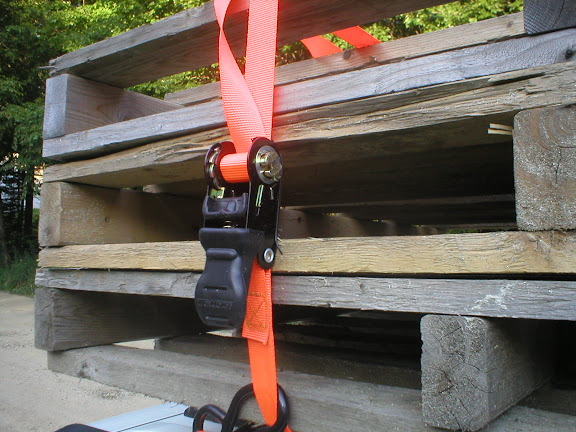
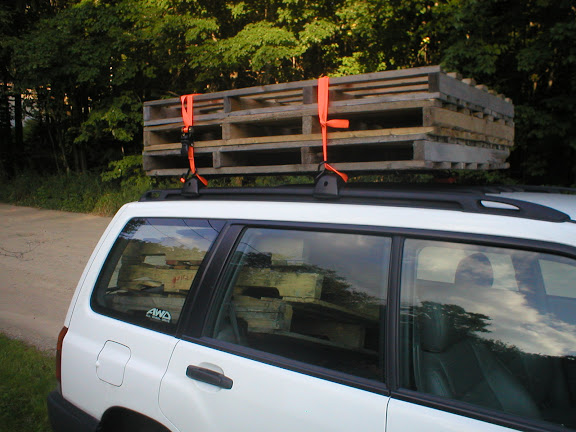
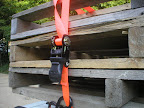
I love my ratcheting straps. One of the greatest inventions ever made. Oh my! I love them. I cannot say enough good things about them. I carry them wherever I go. I look for opportunities to tie things down. If you don't have a set, you should get some. There are few things more satisfying than tying something securely to the top of your car with a good ratcheting strap. Really.
I have just found a good supply of free pallets. A local building supply company says if I just drive around down back, I can pick up as many as I want. Then of course, I get to strap them to the top of my car with my ratcheting straps. Note I also have 4 pallets INSIDE my car. These will be used to keep my wood out of the mud so it can dry. Later, I will get some more to break up and use as kindling.


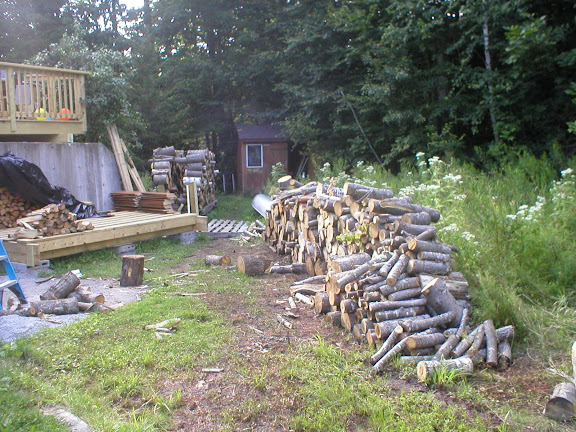
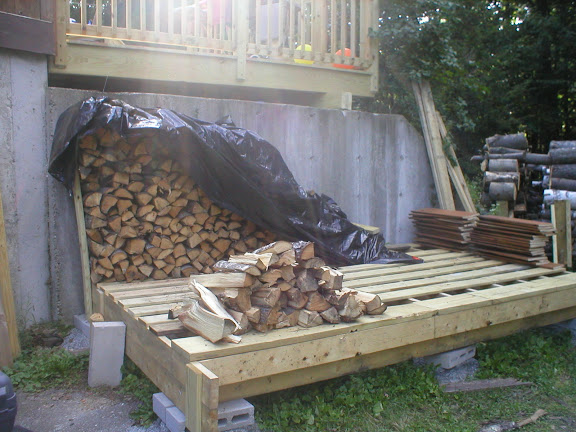
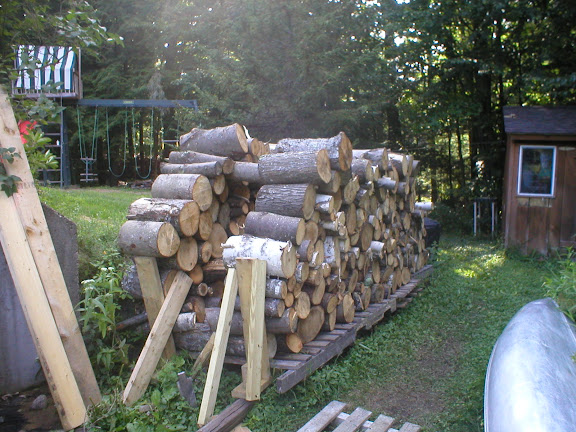
My wood is now in two piles. The near pile is what's left of the original 3 cord, three row pile. Further back you can make out the double stack on pallets, about 2/3 of the entire pile. To the left you see the completed floor of my new woodshed, built entirely of scrap. The only cost has been the cement blocks for the foundation ($1.00 each) and the nails. Nails are suprisingly expensive, and when you actually use them to build something, a box really doesn't go that far.


I have started splitting the wood. Wow. What fun. Big Maul. Fat chunk. Great swing. Big thunk. Nice crack. Do it again. And again. And again. Good honest sweaty fun. Small start. Long ways to go. Gotta fill this whole thing up stacked at least 5 feet high.


This is the stuff I got out of the mud. Spent a whole Saturday afternoon just moving it from the swamp pile to it's new home. I figure I probably picked up and moved 6 or 7 whole trees. When's the last time you've picked up a few trees and moved them across your yard. A little stiff the next day, but good to know that this will all be keeping me warm this winter.


Friday, August 1, 2008

A Life Dominated by Cellulose

Thanks to the tornado, I now have wood. Boy, do I ever have wood. And more to come. Wood to burn and on the side, wood to build.
Here is my nascent woodpile. This is about 1.5 cord. I estimate I need about 4 times this -- at a minimum -- to heat the house this winter. You can see the beginnings of my splitting efforts piled on the left. I have learned the splitting wood with a 16 lb. triangular splitting maul is about as much fun as I have ever had.

Note that the maul came to us for free when my wife picked it up from someone's trash on a whim -- 2 years ago. Had no use for it then. Now? Best thing ever!


As a result of the work on my house's sill and new deck I had some spare 2X6's laying around. This is going to form the base of my new woodshed. I figure it will hold about 4 cord.


For the last 3 months, with fuel prices as they have been, we have been considering buying a woodstove. But with what? Not a lot of spare cash floating around. Then it struck me. Wait! We already have a wood stove. It's right next to the oil furnace. It was enclosed by a previous owner who also didn't use it, and I had forgotten about it. I'll need to tear out the wall that they put in when the "finished" the basement, but it's all hooked up to a seperate chimney flue and it's ready to go. Again, who knew? Now? Best thing ever!


I've already written about Good News/Bad News. Here is the new deck, replacing the old one crushed by the snow that plunged off my roof in March. Should be done in a few days. If the tornado had struck us, I believe the new deck would have anchored our house down to prevent it from being blown away. It is built like a freakin' tank. I love it.


And of course, all that firewood is being provided for us thanks to a disastrous tornado that struck last week. Good can come from evil. I am sad for the people whose houses were damaged. I am especially sad for the family of the lady who was killed in the storm. I am grateful for the wood that will heat my family this winter, and for the love of good friends that is helping me harvest it.

Jehovah Jireh. YHWH Provides.
More on the storm yet to come.